|
|
| Official
Chinese Holidays 2010 |
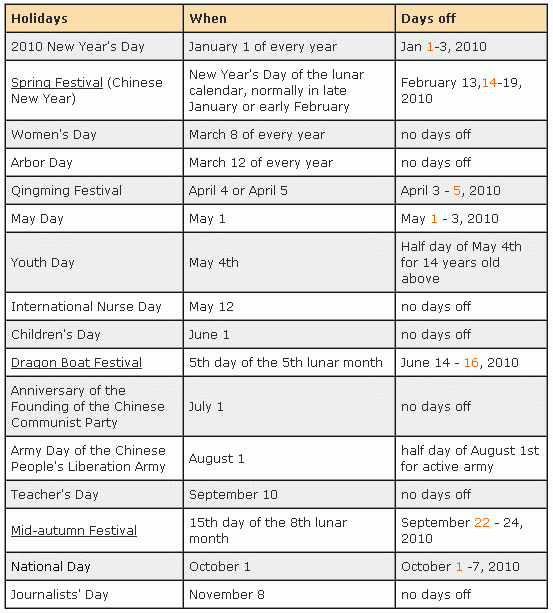
Below is the official public holiday Schedule
in 2010 announced by the State Council in China
Mainland:
Most Chinese holidays are based on the lunar calendar
(Like Easter in the West). Exceptions are usually
fixed days such as May Day and National Day, which
occur on the 1st of the month.
|
|
|
|
| Note: |
|
| 1. Both National Day (Golden
Week) and Spring Festival (Chinese New Year) have associated
one-week holidays, which you should consider to be 10-days
long. |
|
| 2. May holiday also
used to be a one-week break, but this was reduced in
2008 to allow for holidays on other special days such
as Qing Ming (Tomb Sweeping Day), and The Dragon Boat
Festival. |
|
| 3. May holiday
has returned to being a week long break in Guangdong
Province, mainly due to the 40 million migrant workers
who use this to travel home to see family - often located
several days journey away. |
|
| Other
Festivals |
| Lantern Festival |
• 28th February 2010
Chinese traditionally spend the day watching lanterns
and answering lantern riddles. This falls on the
15th day of the 1st lunar month. |
| Buddha's Birthday |
• 21st May 2010
This is not a Mainland holiday or celebration,
but is a public holiday in Hong Kong. |
| Qi Xi |
• 16th August 2010
Also called 7th Eve or Chinese Valentine's Day.
It falls on the 7th day of the 7th lunar month. |
| Chongyang Festival |
• 16th October 2010
A celebration of the ninth day of the ninth lunar
month, which is also called Double Ninth Day. |
| Dongzhi Festival |
• 22nd December 2010
This is a celebration of 'midwinter's day' and
follows the solar calendar Westerners know it
as the Winter Solstice. |
|
|
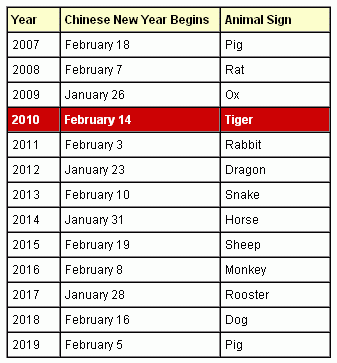
| Chinese
New Year |
|
 |
|
|
| Search
this Website |
|
|
| Our
Friends |
 |

Professional
Visa Services
Company
Formation Packages
.
|
Hollywood
in China

Traveling Workshops:
Film Production, Acting, Makeup, Modeling, Dance/Yoga,
and Voice.
Sacred Rainbow Tour spectacular
China 2010 |

British Foreign Office
Advice for Travellers
Personal Email Updates |
Down
The Road.org
How We Traded Our Ordinary Lives For a Global Bicycle Touring Adventure

See
Us in China |
Excellent
& Free Online Chinese Language Portal

Thousands of free print-friendly Chinese reference sheets,
tests and revision aids.
Easy Learning format &
Listen to Spoken Words |

Chinese Embassy in UK
Information About China
International Relations
Visa & Consular |

UK Embassy in China
Information About UK
International Relations
Visa & Consular |

|
Excel
Education |
Languages Courses
Study Abroad
Employability
Summer Camps
Information for Teachers |
|

Based in Xi'an,
China's Premiere Travel Agency and International Travel
Community -
Committed to providing:
Best travel deals & current information for all
International Travellers |

Based in Shangri-la,
Yunnan
Province
Dedicated to Exploring Remote Areas of China
Committed to Nature Conservation and Preserving Ethnic
Cultures & Traditions
|
|