|
||||||||
| This page is an old page. Please find our new page here: Ip Man new page | ||||||||
Ip Man |
||||||||
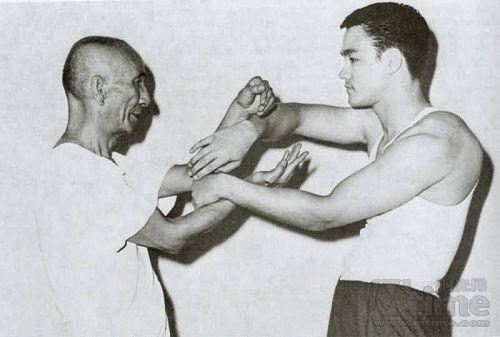
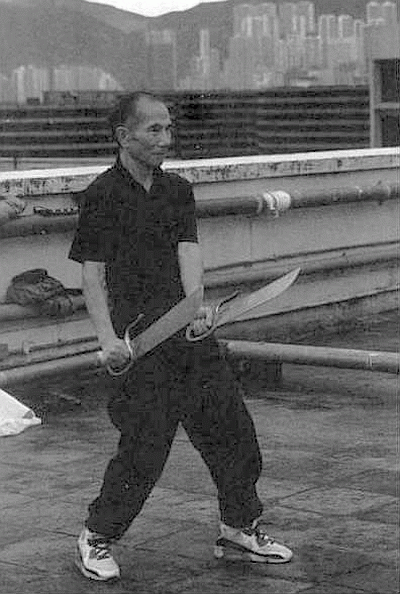
| Ip Man (Yip Man) was a real life person and Wing Chun Grand
Master who lived in Foshan City. During the hardships and atrocities of
the Japanese invasion during WW2, Ip Man became a champion of the ordinary
people, and showed a spirit that could not be broken. He was Grand Master
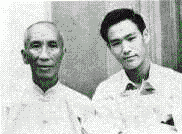
Wing Chun style Kung Fu and Bruce Lee's Sifu. Biography: Yip Man (traditional Chinese: 葉問; simplified Chinese: 叶问; pinyin: yè wèn, Cantonese Jyutping: jip6 man6; Ip Man; also known as 葉繼問 was born: 1 October 1893, died: 2 December 1972) was the first martial arts master (Chinese: Sifu) to teach the Chinese martial art of Wing Chun openly. He had several students who later became martial arts teachers in their own right, including Bruce Lee. |
||||||||
 |
When Yip Man was thirteen years old he started learning
Wing Chun from Chan Wah-shun (陳華順). Because of his sifu's old age, Yip
Man had to learn much of his skills and techniques from his master's second
eldest disciple Ng Chung-sok (吳仲素). Three years into Yip Man’s training
Chan Wah-shun died. One of his dying wishes was to have Ng continue training
Yip. At the age of 15 Yip man moved to Hong Kong with help from Leung Fut Ting, a relative. At age sixteen, Yip Man attended school at St. Stephen's College in Hong Kong . It was a secondary school for wealthy families and foreigners who lived in Hong Kong. According to Yip Man's two sons, while at St. Stephen's Yip Man intervened after seeing a foreign police officer beating a woman. The story goes that the Police officer tried to strike Yip Man who used his martial arts to strike the officer down, at which point Yip Man and his classmate ran to school. The classmate is said to have told an older man who lived in his apartment block. Yip Man was invited to see this man and the man asked Yip Man what martial art he studied. The man then asked Yip Man to show him his first 2 forms (Sil Lim Tao and Chun Kiu). The man then told Ip man that his forms were “not too great. |
|||||||
| Yip Man was then invited to Chi Sau (a form
of training that involves controlled attack and defence), Yip Man saw
this as an opportunity to prove his Kung Fu was good, but he was beaten
after just a few strikes. It turned out that the old man was his master's
elder fellow-disciple (and so, by Chinese tradition Yip Man's martial
uncle), Leung Bik (梁璧), son of his master's master Leung Jan (梁贊). After
that encounter, Yip Man continued his training lessons from Leung Bik.
By the age of 24, Yip Man had returned to Foshan, his Wing Chun skills
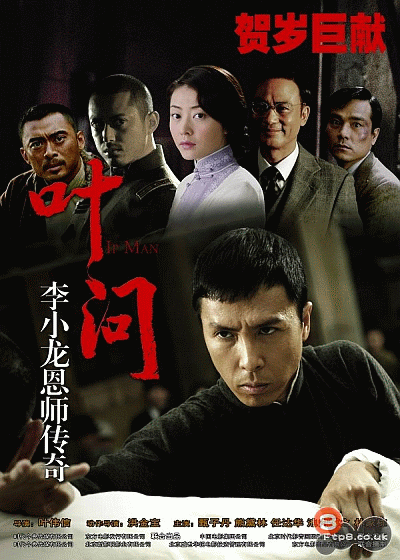
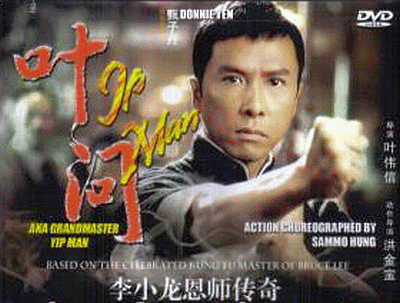
tremendously improved. In Foshan, Yip Man became a policeman. He did not formally run a Wing Chun school, but taught several of his subordinates, his friends and relatives. Amongst those informal students, Lok Yiu, Chow Kwong-yue (周光裕 (六仔)), Kwok Fu (郭富), Lun Kai (倫佳), Chan Chi-sun (陳志新) and Lui Ying (呂應) were amongst the most well-known. Chow Kwong-yue was said to be the best student among his peers, but eventually he went into commerce and dropped out of martial arts all together. Kwok Fu and Lun Kai went on to teach students of their own. Wing Chun in the Foshan and Guangdong area was mainly passed down from these two individuals. Chan Chi-sun died young, and Lui Ying went to Hong Kong. Neither of them took any students. Yip Man went to Kwok Fu's village house during the Japanese Occupation. He only returned to Foshan after the war, to once again take up the job of a police officer. At the end of 1949, after the Communist party won the Chinese civil war, being an officer of the Kuomingtang, he decided to escape to Hong Kong without his family when the Communists had come to Foshan. In Hong Kong, he opened a martial arts school. Initially, business was poor because his students typically stayed for only a couple of months. He moved his school twice, to Hoi Tan Street (海壇街) in Sham Shui Po, and then to Lee Tat Street (利達街) in Yau Ma Tei. By then, some of his students were skilled enough that they were able to start their own schools. Among the first were Leung Sheung, Lok Yiu, Chu Shong-tin, and Wong Shun Leung. Some of Yip Man's students and descendants compared their skills with other martial artists in combat. Their victories over other martial artists helped to bolster Yip Man's reputation as a teacher. In 1967, Yip Man and some of his students established the Hong Kong Ving Tsun Athletic Association (香港詠春拳體育會). In 1972, Yip Man suffered throat cancer and subsequently died on the 2nd of December that same year. Within the three decades of his career in Hong Kong, he established a training system for Wing Chun that eventually spread across the world. Quote: "徒弟選擇一個好師傅, 固然困難, 但師傅選擇一個好徒弟, 更加困難。" - It is difficult for a student to pick a good teacher, but it is even more difficult for a teacher to pick a good student. Films Ip Man A film loosely based on the life of Yip Man was released in 2008 and stars Donnie Yen as the martial artist, Directed by Wilson Yip with the experienced Sammo Hung choreographing the excellent fight scenes. The film takes a number of liberties with Yip Man's life, often for dramatic effect. Yip Man's eldest son Ip Chun appears in the film and served as a consultant for the film. The film focuses on Yip's life during the 1930s to the 1940s during the Second Sino-Japanese War. The film is the first to be based on the life of Yip Man. A sequel to the film is in the works and will focus on Yip's disciples, which includes Bruce Lee. Wong Kar-wai is reportedly working on his own biopic titled The Great Master. The film has been in development and will feature Tony Leung Chiu-Wai as Yip Man. However, it was revealed that Wong's five-year rights to make the Yip Man biopic had expired. Ip Man 2 The sequel was released in 2010 and again starred Donnie Yen as Master Ip Man. The film continues with Director Wilson Yip and fight scenes under the professional watch of Sammo Hung, who this time also stars in the film as a Hung Gar Master opposed to Ip Man's rise. It was originally intended that the film would focus on the young Bruce Lee, who was Ip Man's student and protege in real life. An actor playing Lee aged 10 does make a very minor appearance in the film, but is not a part of any main plot or subplot - just a teaser for the future. However legal wrangles with Lee's estate could not be resolved in time, so a different plot was written by Edmond Wong, son of the Producer Raymond Wong - both again continuing from the first movie. However, the intriguing prospect of Ip Man 3 has movie fans clamoring for more after this sequel proved to be the top grossing film in Hong Kong this year. Unfortunately Donnie Yen has so far ruled out reprising his lead roll, stating that he feels a third film would detract from this excellent and widely acclaimed sequel. However, reports suggest that a third film documenting the relationship between Ip Man and Bruce Lee will be made, and fans may persuade Donnie to take the role again, although in a support capacity to the main plot following Bruce Lee. Ip Man 2 begins where the former left off, with the Grand Master settling in Hong Kong and starting a Wing Chun style Kung Fu school. He has problems with other schools who teach Hung Ga style, and in particular the one run by Hung Chun Nam (Sammo Hung). At first Hung is his nemesis, but later they become firm friends. As well as battling each other and overcoming personal and domestic issues (Ip Man's wife in particular), the great surprise of the film is the excellent portrayal of the British rulers. They show a typically colonial and overbearing approach to governing Hong Kong, including being mixed up in many rackets and profiteering. Whilst this film can in no way be described as faithfully following Ip Man's life, it does concentrate the mind on how China perceives the west, and vice versa. The action scenes are excellent and brilliantly choreographed by Sammo Hung. The fight sequences are fluid and full of action. Most notable is the mix of contrasting Kung Fu styles, with the added bonus of Boxing - all mixed up together. Darren Shahlavi portrays an unbeatable boxing champion, and is a British Boxing Champion is real life - Yen, Yip and Hung were very clear that prominent actors in fight scenes should be fighters in real life, not simply actors. This makes the film very believable - to the point you will want to watch it again, and/or go and get the DVD. There are many websites documenting this film is detail, whereas we would prefer to simply urge you to watch it without giving the plot away. Our link is to Wikipedia, who offer an unbiased and detailed review: http://en.wikipedia.org/wiki/Ip_Man_2 |
||||||||
 |
Martial arts lineage Yip Man's Wing Chun Lineage Ng Mui (Shaolin Nun) Yim Wing Chun (Was taught Wing Chun to defend herself) Leung Bok Chau (Yim Wing Chun's husband) Leung Lan Kwai Wong Wah Bo (Was taught the pole form by Leung Yee Tei) Leung Yee Tei (Added his the pole form to the system he learnt from Wah Bo) Leung Jan (Also taught Leung Bik his son) Chan Wah-shun (陳華順) Yip Man (葉問) also learned from second sihing Ng Chung-sok (吳仲素) sibak Leung Bik (梁璧) Known students: See Branches of Wing Chun |
|||||||
| Yip Man's Legacy Yip Man left a huge legacy of Wing Chun behind him, that now spans across the globe. Yip Man also left behind a written history of Wing Chun. The factual accuracy of Yip Man's account has been debated; however, a translated copy of Yip Man's History is as follows: "The founder of the Wing Chun Kung Fu System, Miss Yim Wing Chun was a native of Canton [Kwangtung Province - they mean Guangdong Province] in China. She was an intelligent and athletic young girl, upstanding and forthright. Her mother died soon after her betrothal to Leung Bok Chau, a salt merchant of Fukien. Her father, Yim Yee, was wrongfully accused of a crime and, rather than risk jail, they slipped away and finally settled down at the foot of Tai Leung Mountain near the border between Yunnan and Sichuan provinces. There they earned a living by running a shop that sold bean curd. During the reign of Emperor K'anghsi of the Ching Dynasty (1662-1722) Kung Fu became very strong in the Siu Lam [Shaolin] Monastery of Mt. Sung, in Henan Province. This aroused the fear of the Manchu government [a non-Chinese people from Manchuria in the North, who ruled China at that time], which sent troops to attack the Monastery. Although they were unsuccessful, a man named Chan Man Wai, a recently appointed civil servant seeking favour with the government, suggested a plan. He plotted with Siu Lam monk Ma Ning Yee and others who were persuaded to betray their companions by setting fire to the monastery while soldiers attacked it from the outside. Siu Lam was burned down, and the monks and disciples scattered. Buddhist Abbess Ng Mui, Abbot Chi Shin, Abbot Pak Mei, Master Fung To Tak and Master Miu Hin escaped and went their separate ways. Ng Mui took refuge in the White Crane Temple on Mt. Tai Leung [also known as Mt. Chai Har]. It was there she met Yim Yee and his daughter Wing Chun from whom she often bought bean curd on her way home from the market. At fifteen, with her hair bound up in the custom of those days to show she was of an age to marry, Wing Chun's beauty attracted the attention of a local bully. He tried to force Wing Chun to marry him, and his continuous threats became a source of worry to her and her father. Ng Mui learned of this and took pity on Wing Chun. She agreed to teach Wing Chun fighting techniques so she could protect herself. Wing Chun followed Ng Mui into the mountains, and began to learn Kung Fu. She trained night and day, until she mastered the techniques. Then she challenged the bully to a fight and beat him. Ng Mui later traveled around the country, but before she left she told Wing Chun to strictly honour the Kung Fu traditions, to develop her Kung Fu after her marriage, and to help the people working to overthrow the Manchu government and restore the Ming Dynasty. After her marriage Wing Chun taught Kung Fu to her husband Leung Bok Chau. He in turn passed these techniques on to Leung Lan Kwai. Leung Lan Kwai then passed them on to Wong Wah Bo. Wong Wah Bo was a member of an opera troupe on board a junk, known to Chinese as the Red Junk. Wong worked on the Red Junk with Leung Yee Tei. It so happened that Abbot Chi Shin, who fled from Siu Lam, had disguised himself as a cook and was then working on the Red Junk. Chi Shin taught the Six-and-a-half-point Long Pole techniques to Leung Yee Tei. Wong Wah Bo was close to Leung Yee Tei, and they shared what they knew about Kung Fu. Together they shared and improved their techniques, and thus the Six-and-a-half-point Long Pole was incorporated into Wing Chun Kung Fu. Leung Yee Tei passed his Kung Fu on to Leung Jan, a well known herbal Doctor in Fat Shan. Leung Jan grasped the innermost secrets of Wing Chun, attaining the highest level of proficiency. Many Kung Fu masters came to challenge him, but all were defeated. Leung Jan became very famous. Later he passed his Kung Fu on to Chan Wah Shan, who took me and my elder Kung Fu brothers, such as Ng Siu Lo, Ng Chung So, Chan Yu Min and Lui Yu Jai, as his students many decades ago. It can thus be said that the Wing Chun System was passed on to us in a direct line of succession from its origin. I write this history of the Wing Chun System in respectful memory of my forerunners. I am eternally grateful to them for passing to me the skills I now possess. A man should always think of the source of the water as he drinks it; it is this shared feeling that keeps our Kung Fu brothers together. Is this not the way to promote Kung Fu, and to project the image of our country? Yip Man" |
||||||||
|
||||||||
| Reproduced under Collective Commons licence
from Wikipedia http://en.wikipedia.org/wiki/Yip_Man Links:Please know all links are working at time of publication. However, these have a tendency to change.Please report broken links so we can change them. Ip Man 1. Click for free online movie: Ip Man Cantonese (New working Link for 2010) 2. Click for free online movie: Ip Man Mandarin 3. Click for free online movie: Ip Man English Subtitles - sorry but we haven't found this again yet, but it will be on Ku6 orYouku somewhere? 4. Or choose one from this Ku6 page of links Note: If searching for Ip Man it is best to use the Mandarin characters 叶问 (Simplified Chinese) not the Cantonese 葉問 (Traditional Chinese) Ip Man 2 1. Ip Man 2 in Mandarin (Mostly) 2. Ip Man 2 Specific search page - many good links here. Note: Ip Man 2 is made in Mandarin, Cantonese and English versions, the DVD having all three options. To search yourselves the best way is by using Chinese characters, and sites such as Youku, Ku6 and Soku + use your initiative! Tudou is about the best of them, but searching is more awkward - but when you find what you want it simply keeps playing all episodes continuously. Mandarin (Simplified Chinese) - 叶问2:宗师传奇 Cantonese (Traditional Chinese) - 葉問2:宗師傳奇 Both mean: Ip Man 2: Legend of a Grandmaster This website is devoted solely to the Ip Man movie and has some excellent resources. Take a look here |
||||||||
  

|
||||||||
 |
||||||||
| Click for Main Website | ||||||||
|
||||||||